Progressive overload is the single most proven principle in strength training. The idea is simple: to get stronger, you have to consistently do a little more than last time — more weight, more reps, more sets.
Every trainer knows this. Every serious lifter knows this. Every sports scientist has known this for decades.
So why does virtually every fitness app still make you guess?
The Spreadsheet Problem
Open any popular fitness app and you’ll find the same UX: a list of exercises, fields for sets and reps, maybe a notes section. You log what you did. The app saves it.
That’s it.
You’re supposed to look at last week’s numbers and figure out what to do this week. That’s the hard part. That’s what takes years of experience to do well. That’s what a personal trainer actually does.
Apps offloaded the most important cognitive work back onto the user, then called themselves “smart.”
Why It’s Harder Than It Looks
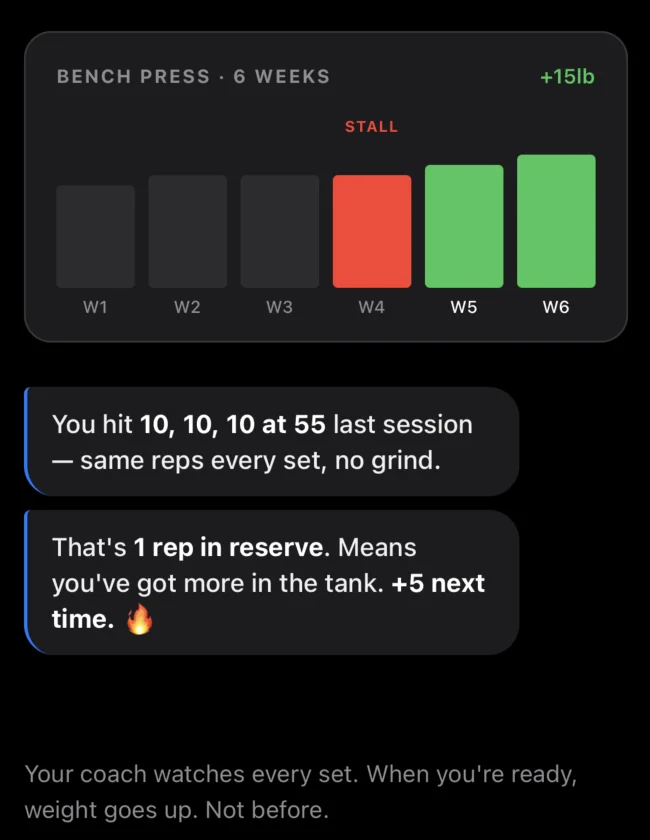
Real progressive overload isn’t just “add 5lbs every session.” That works for beginners for about six weeks. Then it gets complicated.
Take Romanian deadlifts. Last week you hit 10/10/9 at 135. The reps dropped on set 3 — that’s the signal. Adding weight this week probably gets you 9/8/6, which is the wrong direction. The right call is to hold 135, push that lagging third set up until your reps land flat across all three, then add weight. A spreadsheet won’t tell you that. A trainer will. The question is whether your app can.
What “AI Fitness” Usually Means
The last few years brought a wave of “AI-powered” fitness apps. Most of them use AI to do one thing: generate a program at signup.
You fill out a questionnaire. The AI spits out a 12-week program. Then you follow the program.
That’s not AI-powered training. That’s a PDF with extra steps. The AI finished its job before your first workout.
A plan isn’t the problem — you need one. Some structure, a set of exercises to walk in and do. The problem is stopping there. A plan tells you what to train. It can’t tell you how hard, or when you’ve earned more weight. That part has to happen live.
What Actually Needs to Happen
The coach needs to be in the session with you. Not just at the start of your subscription — every rep, every set, every session.
That means knowing what you lifted last time. Knowing when to push and when to hold. Calling out a PR when you hit one. Adjusting on the fly when you swap an exercise.
This is what building Jacked taught me: the hard part isn’t the AI. The hard part is making the feedback loop tight enough to be useful in real time, at the gym, when you’re between sets and your hands are sweaty.
Where We Landed
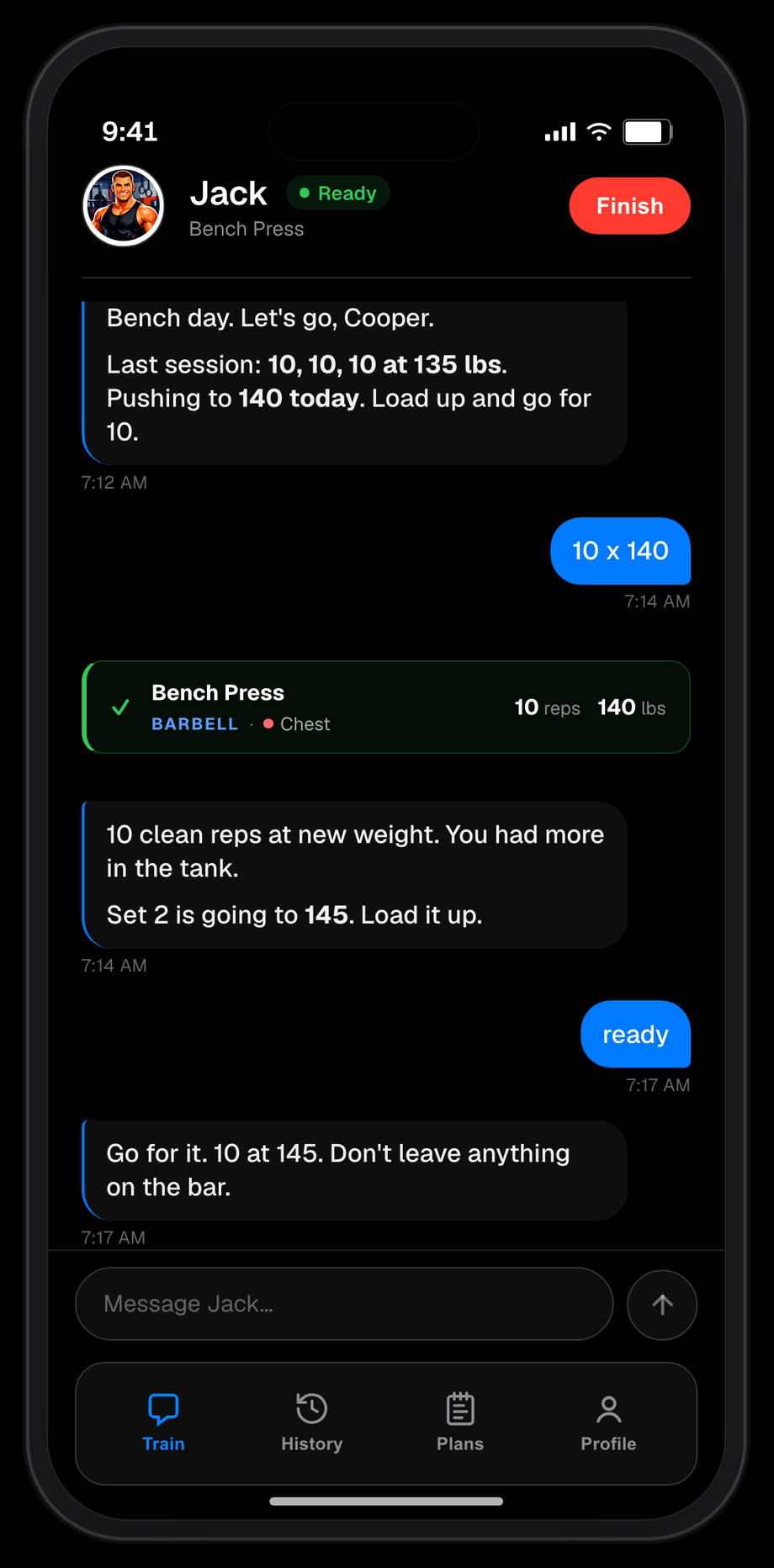
Jacked works like this: you talk to your coach during your workout. “Just did 3x8 at 185” — that’s enough. The coach logs it, compares it to your history, and tells you what to do next set.
Back to those Romanian deadlifts. You type “10/10/9 at 135.” The coach sees the drop on set 3, knows your recent history, and responds: Hold 135. Your third set slipped — even it out before you go up. Go again in 90 seconds. Next session your reps land flat across all three sets, and the coach calls it: go to 145. That’s the loop. Tight, specific, earned.
You build the plan once — the exercises, the split, the order. That part you own. Everything after — how hard, when to add weight, when to hold — happens live, every set, off your actual reps. No spreadsheet to update. No guessing.
It’s not magic. It’s just what good coaching has always looked like.
Jacked is available on the App Store. Download it here.